
A streak counter is one of the most effective behavioral hooks in software. It creates immediate loss aversion: the question changes from “do I feel like working out?” to “am I willing to throw away 24 consecutive days?”
However, streaks have a dangerous shadow side: streak fragility. When an unavoidable disruption hits—illness, red-eye flights, family emergencies—the counter resets to zero. Because the streak became the primary reward, the entire behavior collapses. Here is how to structure streak tracking so it builds momentum without causing anxiety.
1. Implement the Dual-Streak Method
Never track a single streak number in isolation. Maintain two distinct indicators:
- Current Streak: Your active daily momentum. Useful for day-to-day focus.
- Personal Best Streak: Your historical ceiling. This represents permanent proof of your capability.
When life forces a reset on your current streak, your personal best remains intact. You are never starting from zero; you are launching a new attempt to surpass an established high-water mark.
2. Establish a “Bad Day” Baseline Threshold
A habit streak should measure consistency of appearance, not peak performance. If your definition of a workout is 60 minutes of high-intensity training, your streak will break on busy days. Instead, decouple the volume from the check-in:
- Peak Day: 45-minute gym session.
- Baseline Day: 10 pushups and 2 minutes of stretching.
Both count as valid completion. Checking off a baseline day is not “cheating” the streak; it is preserving the neural identity of someone who never skips.
3. Review Patterns with Weekly Heatmaps
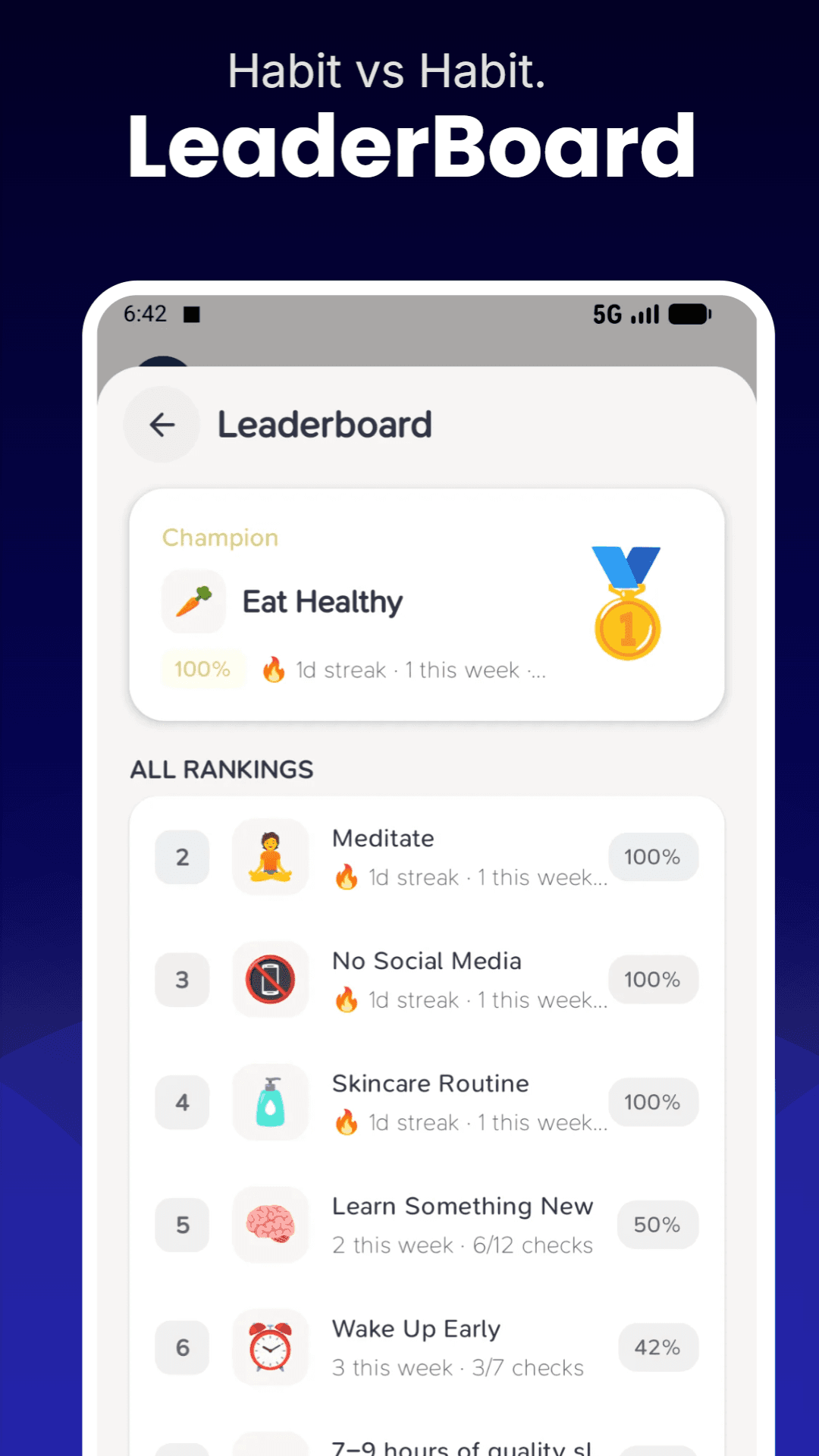
Binary numbers hide trends. Habit First pairs your streak counters with full weekly consistency matrices. This helps you evaluate rolling weekly adherence rather than fixating on a fragile unbroken tally.
4. Pre-Commit to Planned Rest Days
If you run four times a week, a 7-day linear streak is the wrong mechanic. Good trackers support schedule customization (e.g., target 4 days/week). Scheduled rest days should protect your streak, not penalize your recovery. Learn more on this in our critique of why most habit trackers fail.
5. The Immediate Reset Protocol
When a break happens, the critical window is the next 24 hours. Follow the Never Miss Twice rule: execute your baseline version on day two without trying to double your output to compensate.